


Greywolf74
I'M TO BLAME!
Lifetime Supporter!
Supporter
Excellence Award
Hospitality Award
Build Thread Contributor
RC Showcase: 8
In an effort to help refresh and consolidate several posts and stickies, I'm going to compile several threads worth of info and write-ups. If some of the info doesn't necessarily flow from one topic to the next, that is why. Overall, though, this will make a more complete reference for folks to read.
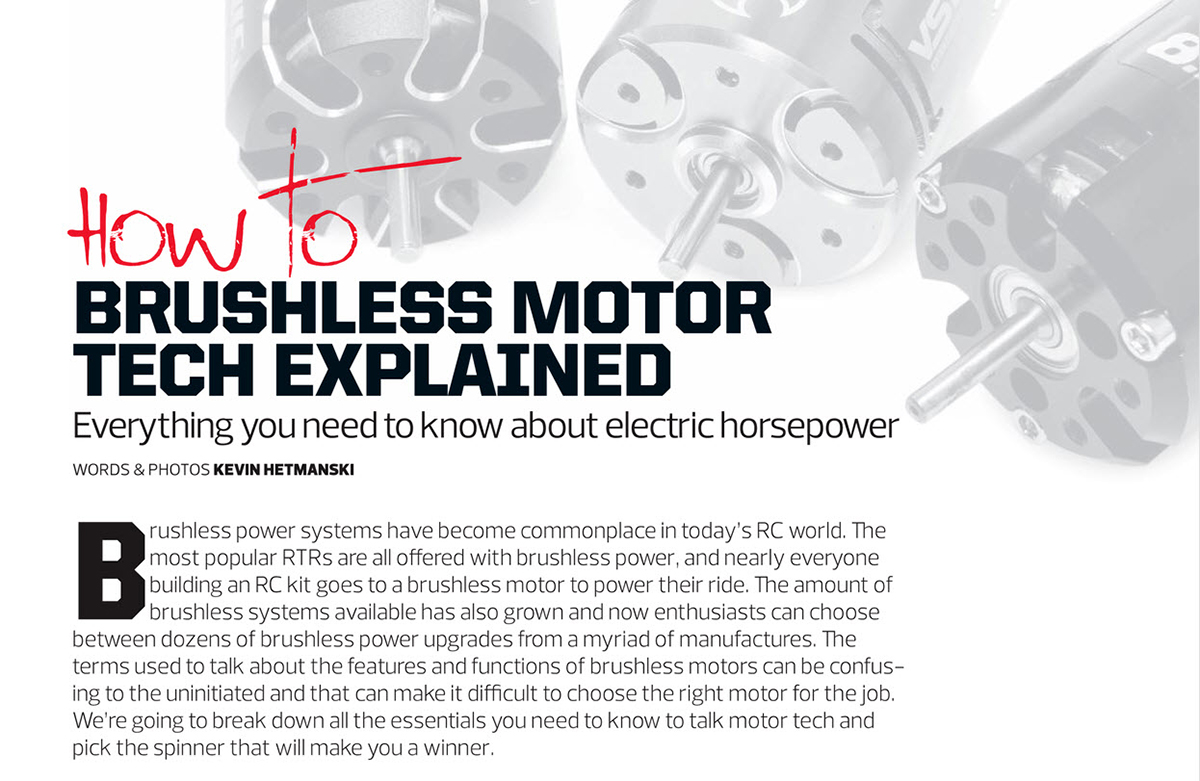
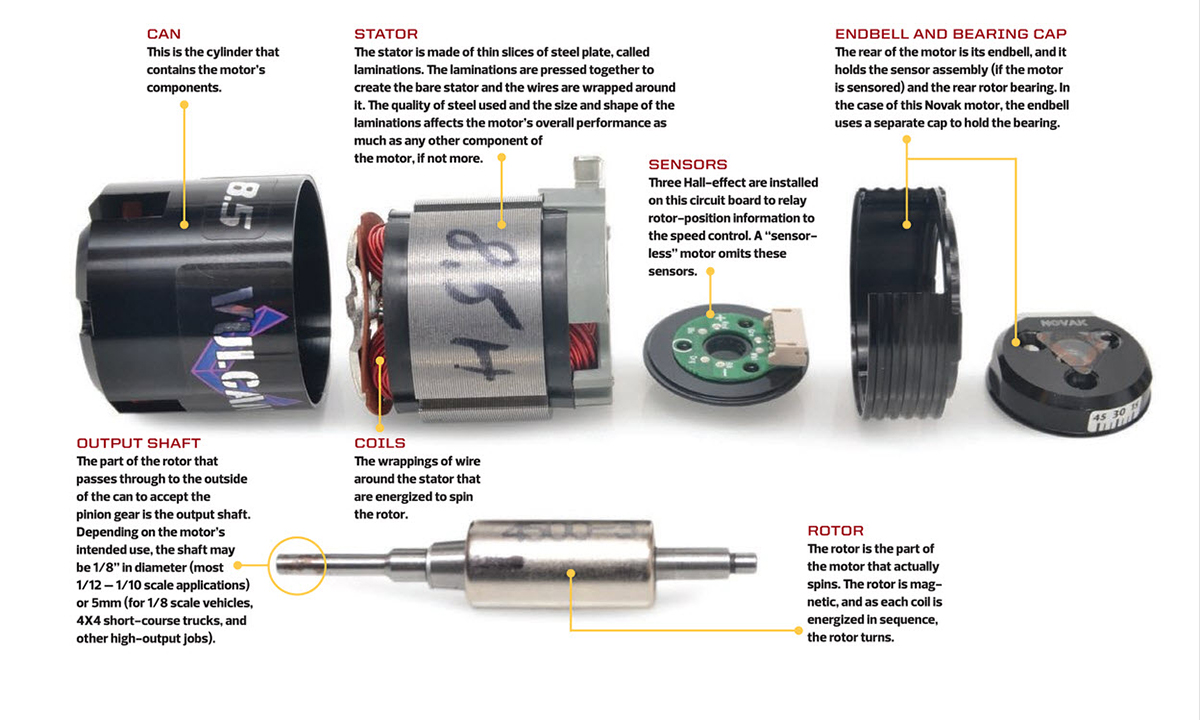
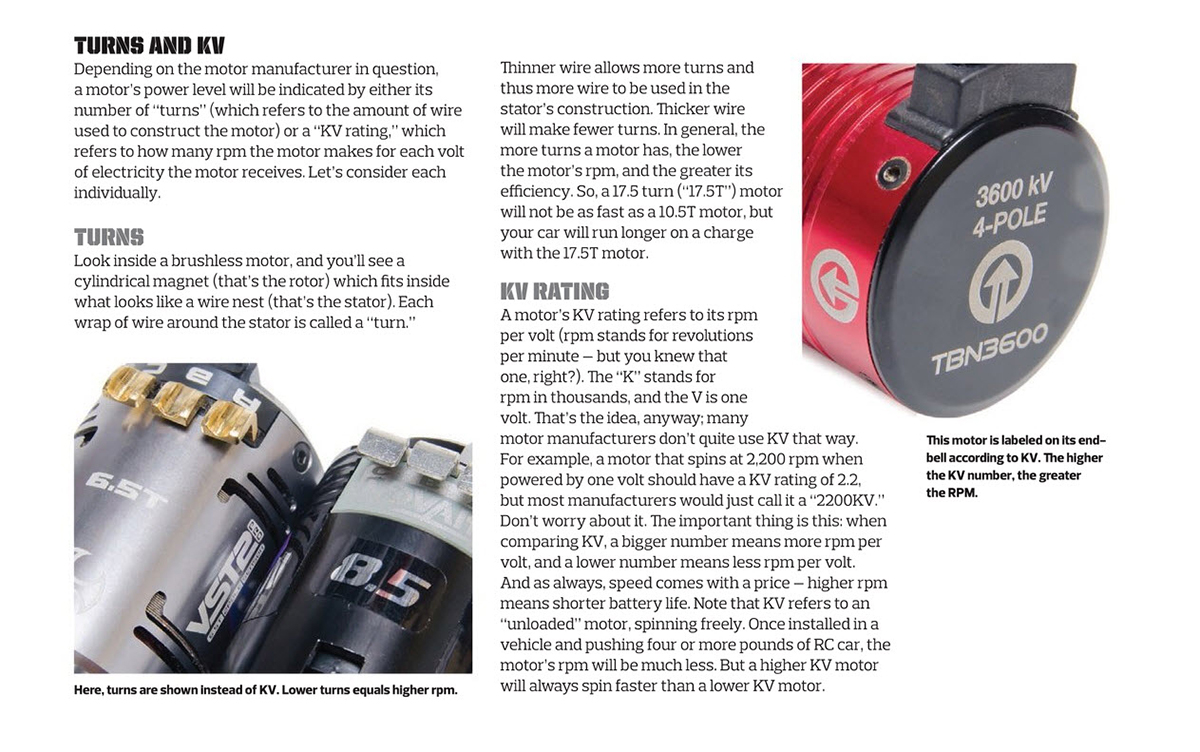
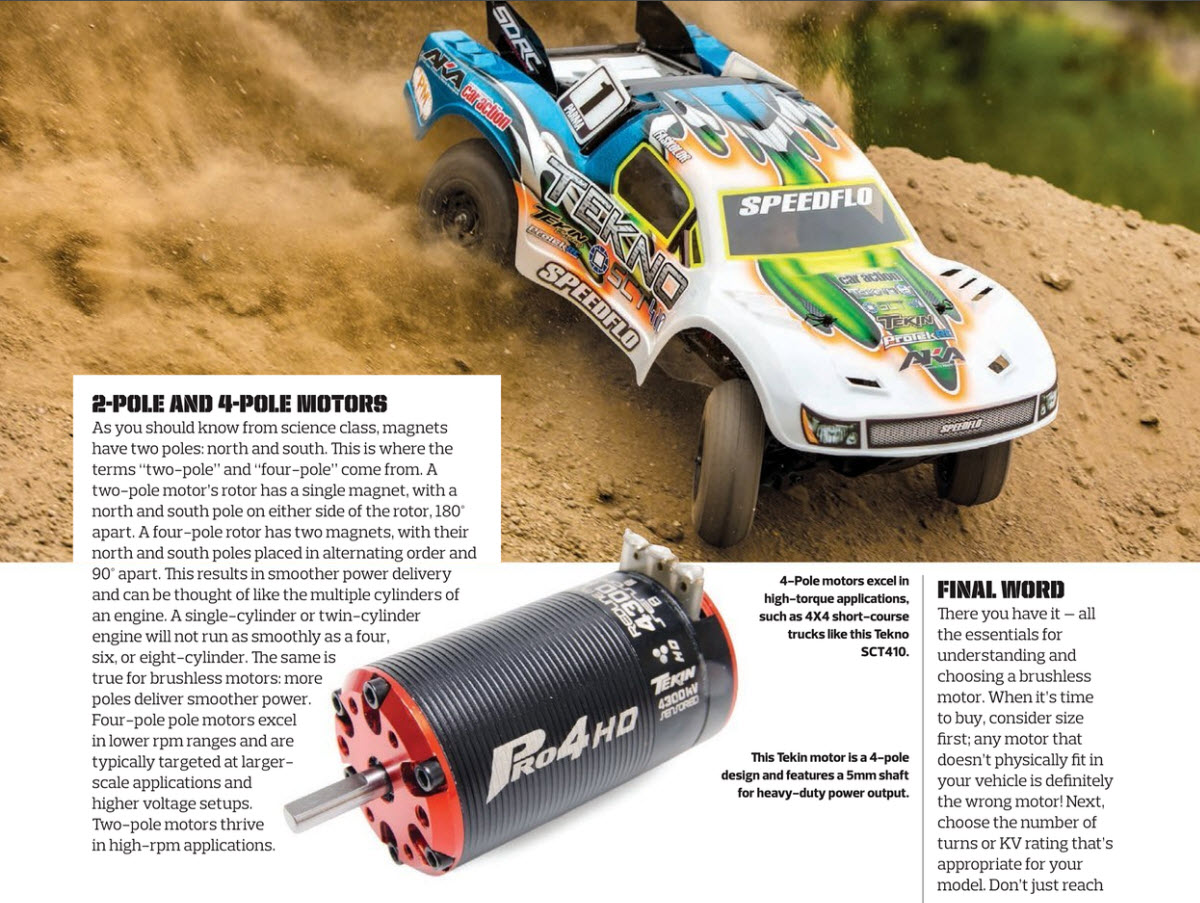
BRUSHLESS MOTOR TECH EXPLAINED:
I showed the nitro side some love by reposting an article I read about glow plugs so I figured Id do the same thing and show the Electric side some love this time
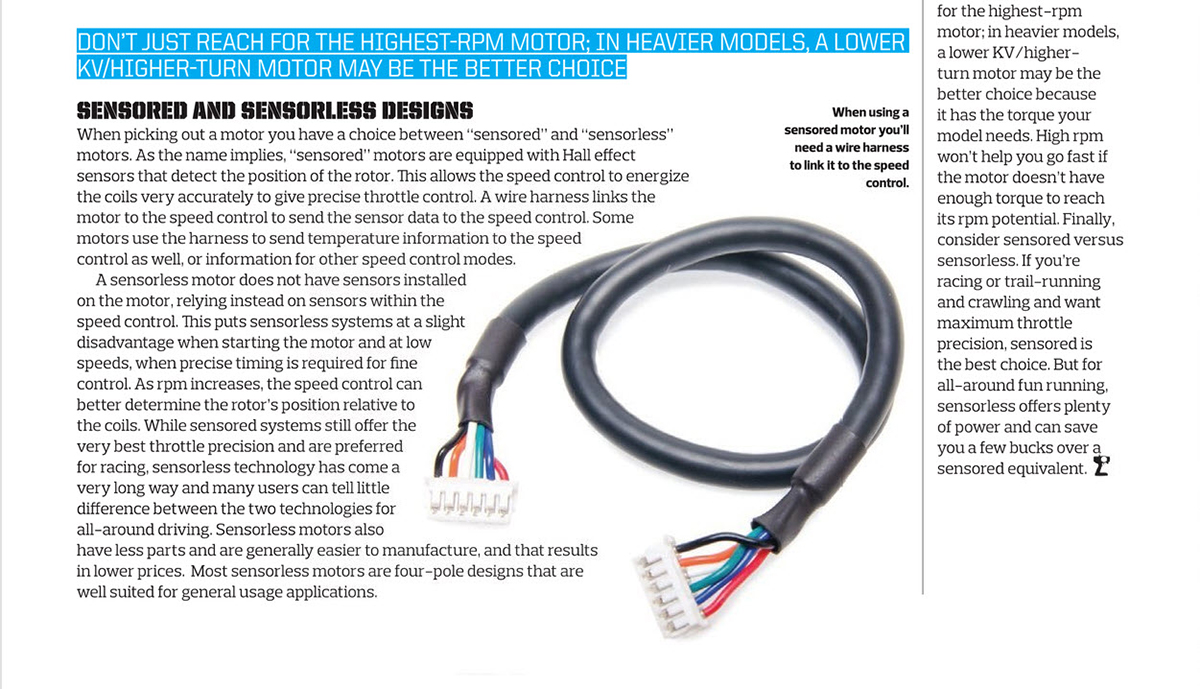
One thing that I would like to add to this is that when they talk about electric motors that are higher RPM the article keeps saying that the tradeoff is shorter battery life. That may be true but the more important trade off that they don't even mention is that of torque. The higher RPM the motor is the less torque it will have. With that in mind Higher RPM doesn't always mean faster either. What I mean by that is this. Lats say you have a 3800kv motor and a 5400kv motor. The 5400kv motor is higher RPM so given that the gearing does not change then yes a 5400kv motor would be faster than a 3800kv motor. However, a 3800kv motor has more torque and because of that you can run a bigger pinion thereby turning that extra torque into speed and sometimes you will actually be better off by choosing this option over simply buying a motor with higher KV ratings (or lower Turn ratings).

View attachment 195951
RC MOTOR CAN SIZES:
Castle size comparison pic.
Going from left to right I believe these are:
2028 - 800kv - 1/5 Scale - 720L can size
1717 - 1650kv - 1/6 Scale - Can size on this motor is odd. Its somewhere between a 700 and a 720 if you're going by the dimensions of it.
1515 - 2200kv - 1/8 Scale - 670 can size
1512 - 1800kv - 1/8 Scale - 670 can size
1415 - 2400kv - 1/10 scale - Another oddball can size but the closest size is a 540XL
1406 - 7700kv - 1/10 scale - 540 can size
View attachment 195949
View attachment 195952
DISPELLING THE MYTH OF LOWER KV EQUALS MORE TORQUE:
I've learned a lot since I originally posted this info. Back in 2017, when I posted this, I believed in the myth that lower kV meant higher torque. I think that myth stems from a misunderstanding of the fact that Kt (torque per ampere) is inversely proportional to Kv (rpm per volt). My current understanding is that the maximum torque a motor can output is dictated by the size of the rotor and the stator. So if you had a 1000kV motor and a 5000kV motor that have the same exact size rotor and stator both motors can generate the same amount of torque. The problem is as the kV goes up the amount of amperage required to generate that torque increases. As amp draws increase the more heat is generated which also means capacity is consumed at a greater rate which Bill's post is a perfect example of that. One way you can bring amp draw down while keeping RPM up is to increase voltage but higher kV motors have lower voltage tolerances because of RPM limits. A given motors RPM limit is dictated by its magnetic capacity. The magnetic capacity of the motor's magnetic (iron) circuit is designed to the relationship: voltage/frequency (V/f). If the frequency drops the V/Hz goes up. This means that the motor needs a larger magnetic circuit. Without it, the magnetic circuit can be overloaded. This is called saturation and it leads to a rapid increase in current draw and a corresponding large increase in temperature, a motor's chief enemy.
View attachment 195953
HOW ARE CRAWLER MOTORS DIFFERENT THAN REGULAR 1/10 SCALE MOTORS?:
@Goose246 asked this question in a different thread awhile back and I could only vaguely answer the question. I tried some google-fu to get more info but really couldnt find much in the way of an informative answer. To that end I reached out to Holmes Hobbies and asked them that question. Here is their reply for anyone interested.
"Good question! Most of the motors you've likely experienced are 3 slot armatures. This of course, means the commutator has three segments. The current being applied makes the motor spin to the next segment. In the case of 3 slots, it jumps 120°, or 1/3 of a full revolution. It takes a decent amount of current and motion to turn that far. Now imagine how that's improved by having a 5 slot motor! Now it takes less current to jump to the next segment and/because the motor doesn't need to spin so far to do it. 72° or 1/5 of a revolution means startup speeds are lower and low speed modulation is much easier.
A good rule of thumb for extrapolating how much load/how fast a 5 slot motor( all Crawlmaster brushed motors are 5 slot) will be (in comparison to a like-sized and constructed 3 slot) is to double the turn count. So, the Crawlmaster Sport 12T is going to behave like a 24T 550 at WOT. Or, a little slower top speed and a little less load than the 12T Titan.
If we're looking at trucks like the Slash and want a more apples to apples comparison, our Trailmaster Sport 550 12T is comparable but likely a slightly slower top speed/lower Kv due to stronger magnetics."
View attachment 195954
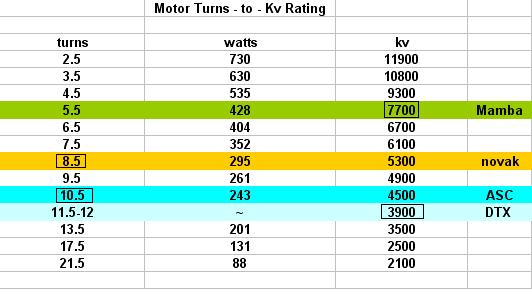
One thing that I see all the time is people confused about the difference between turns and kV. They both are an indication of how fast and/or torque"y" the motor is but theres no direct way of comparing one to the other. The only thing we can do is look up a chart or do some math to come up with an approximation. Most, if not all, of the Turns to kV charts I've found on the internet seem to all be based on a chart that was created by RC Car Action. Ill post their chart below. As far as I can tell, RCCA's chart was based on tests done on 4 different motors (The motors that are highlighted) and the rest were extrapolated from those four results. Someone correct me if I'm wrong about this.
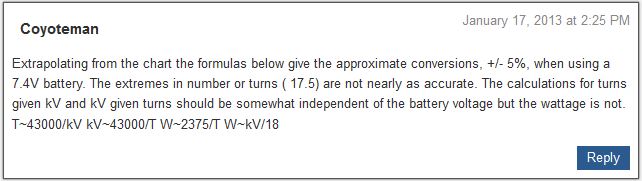
I have also found this formula for approximating kV to turns that was based directly on this chart. Using this formula, as noted below, the approximations get less accurate as you get closer to the extremes. (either really high or really low turn motors).
kV rating is (as most people generally know) is how many RPMs a motor will spin per volt applied to it. For example a 2000kV motor will spin 2000RPM per volt of electricity applied to it. So if you give it 10V it will spin at 20,000RPM.
Turns, on the other hand, are how many times the copper wire inside the motor wraps around each armature of the motor. "kV" is kinda like HP in an engine and "Turns" has more to do with how the engine was built. This is why there is no direct correlation between turns and kV and it can only be approximated.
*NOTE* In the pic below where it says "To Battery" it really should say "To Speed Controller"
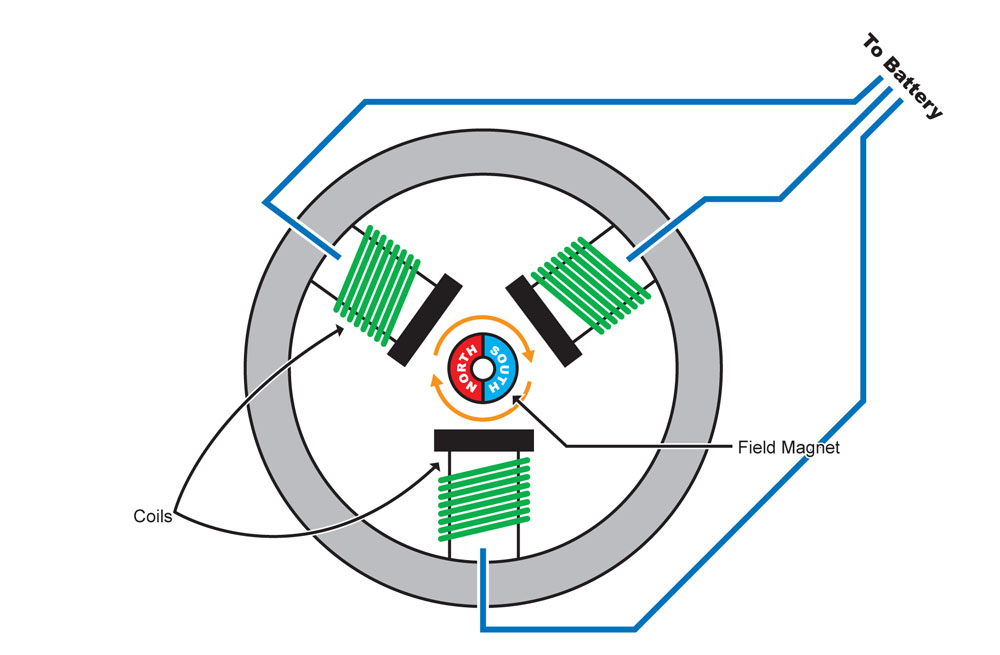
Then there are winds which are different than turns. Youve probably seen on some motors, like Castle Creations motors, Wye and Delta wind types listed. For example we all know the famous Castle 1515 2200kV and if you look at the can it will say 1515/1Y 2200kV on the can. The 1Y tells us that this motor has a 1 Wye wind. What is a wind? I can't say I fully understand everything there is to know about winds but what I do know is the basics. So in the previous paragraph we talked about how a 12T motor has the copper wire wrapped around each armature 12 times. The wind rating is actually a rating signifying two different things. Lets use 12T/1Y as an example. The 12T tells us that the copper wire is wrapped around each armature 12 times. The 1 in 1Y tells us that there is only 1 stand of copper being wound around each of the armatures 12 times. Wye and Delta just signifies the pattern in which the wire is wrapped and terminated before exiting the can to go to the ESC. So if we had a 12T/4D motor then each armature has 4 pieces of wire wrapped around it 12 times in the delta pattern. The pic below will give you a better idea of the difference between a wye and delta wind.
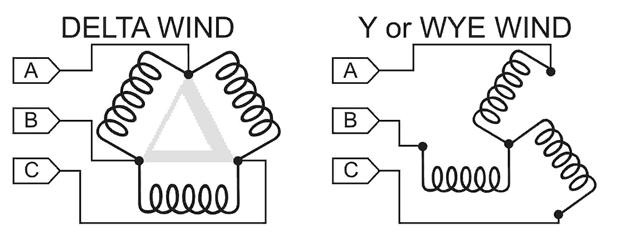
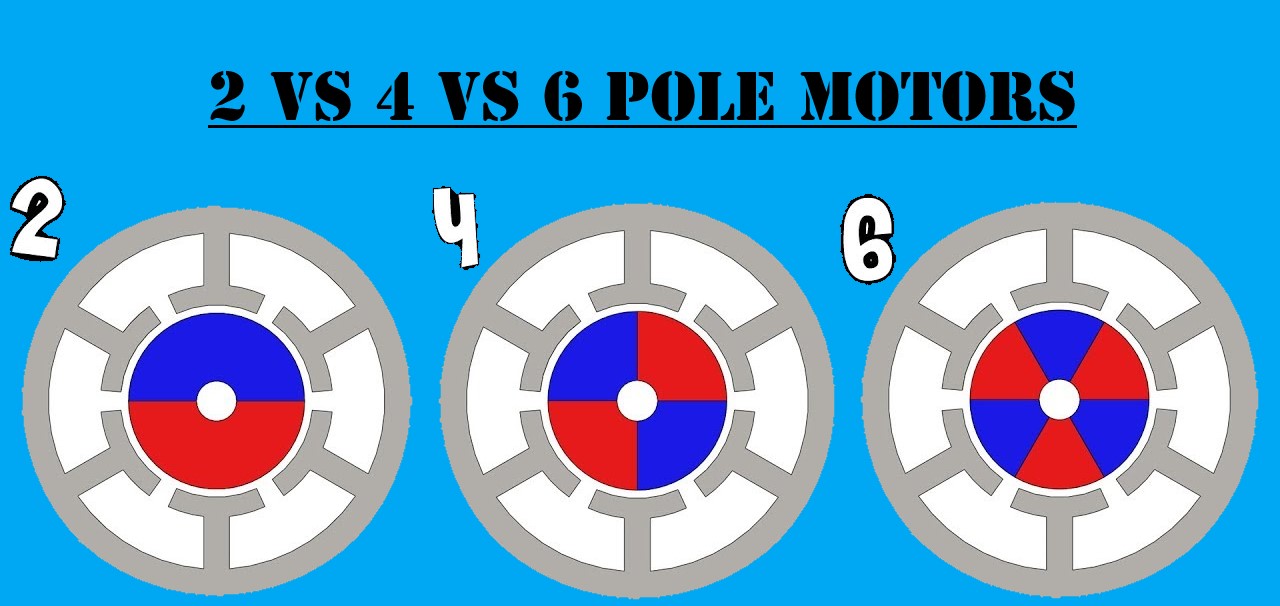
As for poles this has to do with the number of magnetic "poles" inside the motor. A 2pole motor only has two magnets or "poles", a 4 pole has 4, etc etc. The poles or magnets are what is mounted to the "rotor" which is the piece that is essentially the shaft sticking out of the motor. The armatures that have the copper wire wrapped around them are called stators. The more poles the more torque but it also means less RPMs at least generally speaking. Sometimes, there are ways an engineer can make up for a motor having more or less torque/RPMs based on the type of winds used for a given turn rating but I'm not even going to go down that rabbit hole.
I already hear you asking "how can we tell how many poles a motor has?". Well the only sure fire 100% way is to take it apart and visually inspect it (or look at the motors specs) but the vast majority of the time motors that are listed in turns are 2 pole and motors listed with a kV rating are 4 (or more) poles. There are exceptions to this but most of the time this is going to be true at least from what I've read. One other possible way to tell a 2 pole motor from a 4 pole motor is to take a magnet and while holding the rotor still and get the magnet close enough to the motor to feel the push and pull of the poles (you want to keep the magnet off of the motor though) and slowly run it around the motor counting how many times you feel the poles change in one revolution.
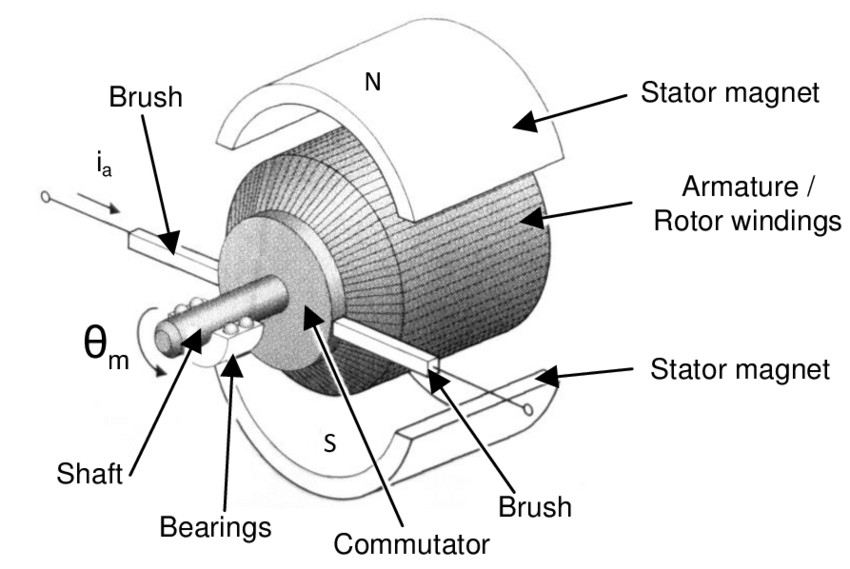
Incidentally if you didnt know this already, brushed motors also have stators and rotors too but the copper wire is wound around the rotor instead of the stator and the magnets are placed on the stator, which in the case of a brushed motor, the stator is basically the entire inside of the can. This is why brushed motors have to have brushes. Since you can't hook wires up directly to a spinning rotor the brushes take the electricity from the wires and transfer it to the rotor. The brushes are pushed against a section of the rotor called the commutator by springs so that they keep in constant contact with it. This is how the turns of copper wire are powered when they are attached to the rotor.
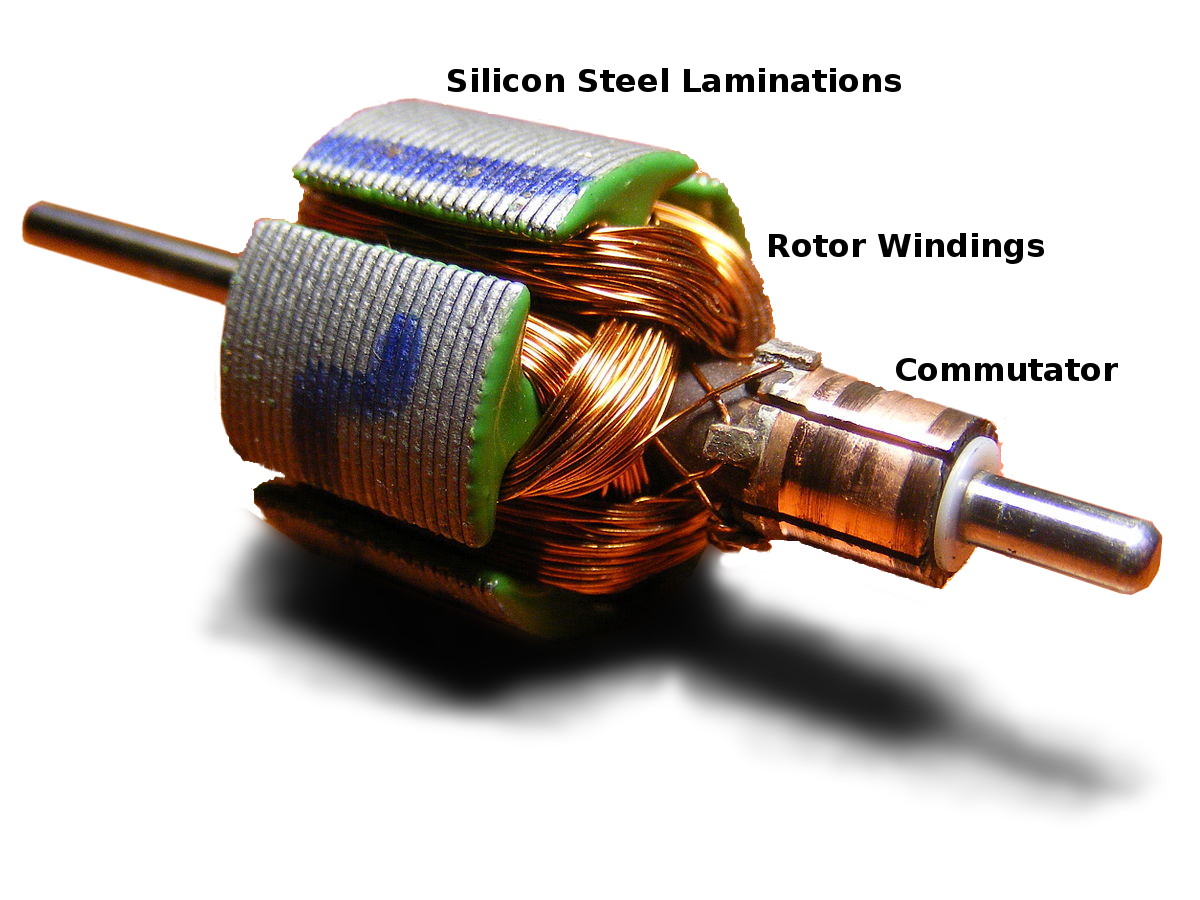
This pic here shows the wear spots from where the brushes were in contact with the commutator while it was spinning. The separations in the commutator are how the rotor activates each section of windings. That way only the section that is in contact with the brushes is active and thats what allows it to "chase" the magnets around and spin.
This is probably waaaaay more in depth than anyone wanted to know but i hope that clears up some of the confusion around turns, winds, kV and poles.
View attachment 195955
Theyre both basically a way to rate how fast the motors are and its generally the only thing that is really considered these days. The type of wind a motor has will give it certain tertiary characteristics but its not something that most people give any consideration too these days. In a motor that is rated in turns the lower the turns the faster the motor and with kV its the opposite, the higher the kV the faster the motor. Of course you generally trade torque for speed so the faster the motor the lower the torque it will have. In the case of kV the kV rating is how you determine the RPM of the motor. kV means for each volt of electricity you put in to the motor you will get that many RPM. So a 3000kV motor for example would spin 3,000RPM with 1 volt applied to it or 30,000RPM with 10 volts. There is no direct comparison between turns and kV unfortunately but there are some charts out there, like the one I posted above, that can help you come up with an estimation.
To more directly address your question here, winds are not something that many people care about these days. Maybe hard core racers or engineers care but the average hobbyist doesn't.
Hope this helps and thanks for the great question!
View attachment 195956
ARE 2 POLE MOTORS FASTER THAN 4 POLE MOTORS?:
So, someone (TurboChargedHonda) in a thread mentioned that 2 pole motors were faster than 4 pole motors. I was intrigued as I had never heard this. The little bit of back and forth got me curious so I started reading up on it and heres some excerpts of what I found for anyone geeky enough to be interested
I'm learning all kinds of stuff about brushless motors lately. Thanks to Bri26 and TurboChargedHonda.
"The speed vs. torque thing comes from induction motors, where pole count does indeed provide a trade-off between speed and torque at a fixed supply voltage and frequency. That relationship does not apply to permanent-magnet motors that are driven with variable voltage and frequency.
Increasing the number of poles does typically lead to less torque ripple and cogging torque, and thus smoother motor performance - especially at low speeds. But increasing the number of poles also typically increases the number of slots (most hobby motors are wound with three slots per pole pair), and so we lose a bit of surface area in the stator with which to collect magnet flux, and so we might see a slight drop-off in performance (higher kV for the same number of turns per phase). 4-pole motors may also have more end-turn resistance per phase (we need to run more wire in the motor in order to connect those additional poles). Both of these things would tend to add up to a bit more resistance per phase, and so copper losses (heat) will be increased.
Perhaps more significantly for high-speed hobby motors, doubling the number of poles also doubles the electrical frequency (the rate at which current through each phase must be switched). This increases switching losses in the ESC as well as the iron losses in the motor.
It's not as simple as saying that one is "better". Generally speaking, you want more poles for larger motors (such as 1/8-scale stuff), and/or for lower-speed operation. But there are other ways to decrease the torque ripple and cogging torque of a small two-pole motor, and so I certainly wouldn't make a blanket statement claiming that more poles = more better."
"All else equal, yes - but all else is rarely equal, and so I wouldn't use this as the sole reason to pick a 2-pole over a 4-pole motor. For example, maybe I decide to play around with the magnet and/or stator geometry on a 2-pole motor in order to reduce cogging torque, and those changes might negate any advantage that the 2-pole motor had in terms of efficiency.
The bottom line is that a motor designer has a lot of choices to make and compromises to balance, and this is but one part of the overall puzzle. Sorry for the wishy-washy response, but this isn't the sort of thing that has a simple black-or-white answer."
"Motors don't draw current at idle.
Lower kv with more supply voltage is always a good idea, assuming that the ESC is rated accordingly."
Quote:
"The average torque will not differ between two motors of the same kv. There is a parameter called kt (unit torque per unit current) that isn't used in the hobby industry, but is commonly used elsewhere, and if you do the math, you can easily see that kt is absolutely linked 100% to kv (it's an inverse relationship). So, two motors of the same kv rating also have the same kt rating; there is absolutely no other way.
What does vary is the ripple and detent torque of a given motor (what we call "torque perturbation"), and this torque is constantly added to/subtracted from the rotor as it spins. A motor with high torque perturbation can have significant torque peaks and dips, which can affect starting and low-speed operation. There are techniques to reduce these effect, but they tend to decrease flux linkage and thus it hurts the average torque of the motor. Like any other engineering exercise, it's all a matter of managing trade-offs."
Quote:
"Doesn't quite work that way. A "properly-designed" 3-phase motor (one with perfectly sinusoidal BEMF) will have constant torque around the entire rotation of the shaft, no matter the position of the rotor or the number of poles. I can design a 2-pole motor that has no torque pertubation and thus provides constant torque all the way around a full rotation. Now, it tends to be easier in practice to do this with a larger number of poles, particularly as the motor increases in size, and a 36mm diameter hobby motor falls into a bit of a grey zone where I could make arguments for either a 2-pole or 4-pole design. It's quite possible to design a smooth 2-pole motor, and it's quite possible to design a ripply 4-pole motor.
What's more important than the number of poles is that the designer understands the usage of the motor and has the skill to optimize the motor for that task. I know that's a lot tougher than saying "2 poles bad 4 poles good" or whatever it is that one wishes to believe, but such is life."
"Since you have gotten the tech side out of the way, lol....
Used to be that two poles just didn't produce controllable torque in a crawler, and four poles were generally more controllable at low RPMs. Turns out it was lazyness of companies releasing "crawler" motors that had zero engineering done to them, simply race motors that may have a larger rotor thrown in. I spent some time refining a two pole and was very surprised to find that they can perform just as well as four pole at low speed. TrailMaster Pro is what came out of that work.
After working on the two pole, I focused on the four pole. With equal motor length and 36mm diameter, four pole can have a torque density advantage because of the increased flux gap area. Even though there is typically more end turn losses (depending on whether distributed or concentrated winding pattern is used), we also have a lower terminal resistance for equal KV of equivalent two pole. So four pole can have both power and torque advantage within the same motor size. ESC switching losses and steel losses do not offset this gain, in practice a four pole has both torque and power density advantage.
Working backwards, a four pole with equal power and torque of a two pole can be constructed smaller and lighter. This is where the Puller Pro 540 Stubby came from. I used the flux gap area of a my two pole to identify an equal FGA in four pole, landing at 15mm long stator stack. It is shorter and lighter than the TrailMaster Pro, but feels very similar on the rocks.
The performance or size factor of 4 pole comes at a price, and that is more expensive construction. It is basically the only downside to four pole, it costs more to make. Where theory and construction meet (in a crawler with the RPMs we need), the four pole does have an advantage of either smaller size for the same performance or higher performance in the same size."
"As you know and have stated, design is always a trade off. Reducing torque ripple to improve low speed feel typically reduces flux linkage, and thus peak torque or power. Over the years we have found that a controllable motor wins over brute power, and the effort of chasing "max" numbers can be a waste of time where rubber meets the ground.
The current 4 pole offerings have about 10% higher Kv (10% higher terminal resistance) than what is "optimal" for power. On the u4 tracks they still run faster laps, are smoother in and out of corners, and keep nice and cool. We do have a special run of race motors in production that split the middle though, using higher grade magnets combined with a low ripple shape to get back the 10% while keeping that buttery smooth control. Trade off, higher costs and higher idle current. But in a race situation, a little more lamination loss is overshadowed by 10% lower copper losses. End effect is a very punchy AND controllable motor that runs super cool and doesn't fade as much during a race."

BRUSHLESS MOTOR TECH EXPLAINED:
I showed the nitro side some love by reposting an article I read about glow plugs so I figured Id do the same thing and show the Electric side some love this time
One thing that I would like to add to this is that when they talk about electric motors that are higher RPM the article keeps saying that the tradeoff is shorter battery life. That may be true but the more important trade off that they don't even mention is that of torque. The higher RPM the motor is the less torque it will have. With that in mind Higher RPM doesn't always mean faster either. What I mean by that is this. Lats say you have a 3800kv motor and a 5400kv motor. The 5400kv motor is higher RPM so given that the gearing does not change then yes a 5400kv motor would be faster than a 3800kv motor. However, a 3800kv motor has more torque and because of that you can run a bigger pinion thereby turning that extra torque into speed and sometimes you will actually be better off by choosing this option over simply buying a motor with higher KV ratings (or lower Turn ratings).
View attachment 195951
RC MOTOR CAN SIZES:
Castle size comparison pic.
Going from left to right I believe these are:
2028 - 800kv - 1/5 Scale - 720L can size
1717 - 1650kv - 1/6 Scale - Can size on this motor is odd. Its somewhere between a 700 and a 720 if you're going by the dimensions of it.
1515 - 2200kv - 1/8 Scale - 670 can size
1512 - 1800kv - 1/8 Scale - 670 can size
1415 - 2400kv - 1/10 scale - Another oddball can size but the closest size is a 540XL
1406 - 7700kv - 1/10 scale - 540 can size
View attachment 195949
View attachment 195952
DISPELLING THE MYTH OF LOWER KV EQUALS MORE TORQUE:
I've learned a lot since I originally posted this info. Back in 2017, when I posted this, I believed in the myth that lower kV meant higher torque. I think that myth stems from a misunderstanding of the fact that Kt (torque per ampere) is inversely proportional to Kv (rpm per volt). My current understanding is that the maximum torque a motor can output is dictated by the size of the rotor and the stator. So if you had a 1000kV motor and a 5000kV motor that have the same exact size rotor and stator both motors can generate the same amount of torque. The problem is as the kV goes up the amount of amperage required to generate that torque increases. As amp draws increase the more heat is generated which also means capacity is consumed at a greater rate which Bill's post is a perfect example of that. One way you can bring amp draw down while keeping RPM up is to increase voltage but higher kV motors have lower voltage tolerances because of RPM limits. A given motors RPM limit is dictated by its magnetic capacity. The magnetic capacity of the motor's magnetic (iron) circuit is designed to the relationship: voltage/frequency (V/f). If the frequency drops the V/Hz goes up. This means that the motor needs a larger magnetic circuit. Without it, the magnetic circuit can be overloaded. This is called saturation and it leads to a rapid increase in current draw and a corresponding large increase in temperature, a motor's chief enemy.
View attachment 195953
HOW ARE CRAWLER MOTORS DIFFERENT THAN REGULAR 1/10 SCALE MOTORS?:
@Goose246 asked this question in a different thread awhile back and I could only vaguely answer the question. I tried some google-fu to get more info but really couldnt find much in the way of an informative answer. To that end I reached out to Holmes Hobbies and asked them that question. Here is their reply for anyone interested.
"Good question! Most of the motors you've likely experienced are 3 slot armatures. This of course, means the commutator has three segments. The current being applied makes the motor spin to the next segment. In the case of 3 slots, it jumps 120°, or 1/3 of a full revolution. It takes a decent amount of current and motion to turn that far. Now imagine how that's improved by having a 5 slot motor! Now it takes less current to jump to the next segment and/because the motor doesn't need to spin so far to do it. 72° or 1/5 of a revolution means startup speeds are lower and low speed modulation is much easier.
A good rule of thumb for extrapolating how much load/how fast a 5 slot motor( all Crawlmaster brushed motors are 5 slot) will be (in comparison to a like-sized and constructed 3 slot) is to double the turn count. So, the Crawlmaster Sport 12T is going to behave like a 24T 550 at WOT. Or, a little slower top speed and a little less load than the 12T Titan.
If we're looking at trucks like the Slash and want a more apples to apples comparison, our Trailmaster Sport 550 12T is comparable but likely a slightly slower top speed/lower Kv due to stronger magnetics."
View attachment 195954
TURNS, WINDS, KV, AND POLES EXPLAINED:
Electric RCs can be confusing especially for people that are newer to the hobby and, some aspects of electrics can be confusing even to RC veterans, so I thought Id take a few minutes and explain some things that tends to trip people up. This post is going to attempt to explain what "Turns", "Winds", "kV", and "Poles" are in DC motors.One thing that I see all the time is people confused about the difference between turns and kV. They both are an indication of how fast and/or torque"y" the motor is but theres no direct way of comparing one to the other. The only thing we can do is look up a chart or do some math to come up with an approximation. Most, if not all, of the Turns to kV charts I've found on the internet seem to all be based on a chart that was created by RC Car Action. Ill post their chart below. As far as I can tell, RCCA's chart was based on tests done on 4 different motors (The motors that are highlighted) and the rest were extrapolated from those four results. Someone correct me if I'm wrong about this.
I have also found this formula for approximating kV to turns that was based directly on this chart. Using this formula, as noted below, the approximations get less accurate as you get closer to the extremes. (either really high or really low turn motors).
kV rating is (as most people generally know) is how many RPMs a motor will spin per volt applied to it. For example a 2000kV motor will spin 2000RPM per volt of electricity applied to it. So if you give it 10V it will spin at 20,000RPM.
Turns, on the other hand, are how many times the copper wire inside the motor wraps around each armature of the motor. "kV" is kinda like HP in an engine and "Turns" has more to do with how the engine was built. This is why there is no direct correlation between turns and kV and it can only be approximated.
*NOTE* In the pic below where it says "To Battery" it really should say "To Speed Controller"
Then there are winds which are different than turns. Youve probably seen on some motors, like Castle Creations motors, Wye and Delta wind types listed. For example we all know the famous Castle 1515 2200kV and if you look at the can it will say 1515/1Y 2200kV on the can. The 1Y tells us that this motor has a 1 Wye wind. What is a wind? I can't say I fully understand everything there is to know about winds but what I do know is the basics. So in the previous paragraph we talked about how a 12T motor has the copper wire wrapped around each armature 12 times. The wind rating is actually a rating signifying two different things. Lets use 12T/1Y as an example. The 12T tells us that the copper wire is wrapped around each armature 12 times. The 1 in 1Y tells us that there is only 1 stand of copper being wound around each of the armatures 12 times. Wye and Delta just signifies the pattern in which the wire is wrapped and terminated before exiting the can to go to the ESC. So if we had a 12T/4D motor then each armature has 4 pieces of wire wrapped around it 12 times in the delta pattern. The pic below will give you a better idea of the difference between a wye and delta wind.
As for poles this has to do with the number of magnetic "poles" inside the motor. A 2pole motor only has two magnets or "poles", a 4 pole has 4, etc etc. The poles or magnets are what is mounted to the "rotor" which is the piece that is essentially the shaft sticking out of the motor. The armatures that have the copper wire wrapped around them are called stators. The more poles the more torque but it also means less RPMs at least generally speaking. Sometimes, there are ways an engineer can make up for a motor having more or less torque/RPMs based on the type of winds used for a given turn rating but I'm not even going to go down that rabbit hole.
I already hear you asking "how can we tell how many poles a motor has?". Well the only sure fire 100% way is to take it apart and visually inspect it (or look at the motors specs) but the vast majority of the time motors that are listed in turns are 2 pole and motors listed with a kV rating are 4 (or more) poles. There are exceptions to this but most of the time this is going to be true at least from what I've read. One other possible way to tell a 2 pole motor from a 4 pole motor is to take a magnet and while holding the rotor still and get the magnet close enough to the motor to feel the push and pull of the poles (you want to keep the magnet off of the motor though) and slowly run it around the motor counting how many times you feel the poles change in one revolution.
Incidentally if you didnt know this already, brushed motors also have stators and rotors too but the copper wire is wound around the rotor instead of the stator and the magnets are placed on the stator, which in the case of a brushed motor, the stator is basically the entire inside of the can. This is why brushed motors have to have brushes. Since you can't hook wires up directly to a spinning rotor the brushes take the electricity from the wires and transfer it to the rotor. The brushes are pushed against a section of the rotor called the commutator by springs so that they keep in constant contact with it. This is how the turns of copper wire are powered when they are attached to the rotor.
This pic here shows the wear spots from where the brushes were in contact with the commutator while it was spinning. The separations in the commutator are how the rotor activates each section of windings. That way only the section that is in contact with the brushes is active and thats what allows it to "chase" the magnets around and spin.
This is probably waaaaay more in depth than anyone wanted to know but i hope that clears up some of the confusion around turns, winds, kV and poles.
View attachment 195955
FOLLOW UP QUESTIONS TO "TURNS, WINDS, KV, AND POLES EXPLAINED":
Unfortunately I'm not old school enough to have been around for the double and quint terminology but basically these days motor are either given a turn rating or a kV rating. The vast majority of the time 2 pole motors are listed in turns and 4 pole or 6 pole motors are listed in kV. Also you generally only see turn ratings on 1/10 scale (or maybe smaller) motors, I honestly can't say why. I have a feeling that turn ratings may have been completely replaced by kV ratings if they didnt use it as a general way to distinguish 2 pole motors from 4 pole motors. Thats just a guess though. I can't say for sure.So curious - as I come from the old days, and still can't make sense of the KV vs. winds/turns.
What number of turns are there in say 1/8th scale brushless motors? The KV numbers change, but do we care about the number of winds anymore? It used to be you could have 6 or 7 turns all the way into the high teens in modified motors, and then each of those turns could have singles, doubles, etc. in the number of winds per turn. You'd get more torque with lower numbers of winds, but higher RPMs with higher numbers of winds. There would be some overlap along the graph of say, 9 Quint, vs. 14 Double.
Theyre both basically a way to rate how fast the motors are and its generally the only thing that is really considered these days. The type of wind a motor has will give it certain tertiary characteristics but its not something that most people give any consideration too these days. In a motor that is rated in turns the lower the turns the faster the motor and with kV its the opposite, the higher the kV the faster the motor. Of course you generally trade torque for speed so the faster the motor the lower the torque it will have. In the case of kV the kV rating is how you determine the RPM of the motor. kV means for each volt of electricity you put in to the motor you will get that many RPM. So a 3000kV motor for example would spin 3,000RPM with 1 volt applied to it or 30,000RPM with 10 volts. There is no direct comparison between turns and kV unfortunately but there are some charts out there, like the one I posted above, that can help you come up with an estimation.
To more directly address your question here, winds are not something that many people care about these days. Maybe hard core racers or engineers care but the average hobbyist doesn't.
We care about the number of turns if a motor is rated in turns. If its rated in kV we use the kV rating instead of the turn rating to the same end. These days we generally do not care about thickness of wire or the type of wind. Most people couldnt tell you what a turn is let alone a wind. If its a 2 pole motor than the turns are used to determine the speed of the motor and likewise if its 4 pole or more motor than kV is used to make that same determination. Some motors do have the wind type listed on them too but its not a consideration most of the RC world cares about. Again, maybe you're really hard core racers might, IDK. I'm not a racer. I'm just a basher.I'm gathering we just don't care about the number of turns or the thickness of the wire anymore, or the number of wires/winds of each turn. But maybe it does matter. Curious why these motors don't state anything but KV.
This is a really good question that I honestly dont have an answer for. Its not even something I've really stopped to consider. What makes a 17.5T motor the same speed as another brand 17.5 because they can play with number of strands, wind types, wire gauge etc to give two different 17.5T motors completely different characteristics. The only thing I can guess (I dont have time tonight to do any online research on it) is that there is some sort of industry standard that says a 17.5T motors must falls within X/Y/Z guidelines and the manufacturers just build the motors anyway they want to get a 17.5T to perform within a certain range in order to be called a 17.5T. That of course is purely speculation on my part. I'll have to look in to that when I get more time. It could be that the speed and torque of various 17.5T motors are drastically different too and you either just have to know enough about motors to understand how all of those aspects impact a motor or you just have to experiment to see which motor gives you the best lap times. Your average basher isnt going to care if they have a "hot" 17.5T motor or a "torque-y" one. Actually your average basher probably isnt even using a 2 pole motor in the first place unless its in a drift car, No Prep car, or maybe an on road car.Now I'm seeing 1/10th motors at 13.5, 17.5, etc. What does that mean? 17 turns yeah, but what's the .5? That's what we used to call a 17 Quint. Or are all brushless motors just single winds, and the turns are all that matters? If I hand-wound a motor, without having to adhere to a spec of anything but the number of turns, I can play with copper gauge of those windings to make my motor faster or have more torque.
kV and Turns are two ways to relay the same basic information. Which is "how fast is this motor?"Edit - also after some further thought, I'd still like to hear about this, but my guess is that there's no single way to determine power/efficiency of a motor without implicitly saying turns/winds/gauge of wire, etc., and that KV is simply a way to take all of that into consideration and put it into a single rating/number.
Hope this helps and thanks for the great question!
View attachment 195956
ARE 2 POLE MOTORS FASTER THAN 4 POLE MOTORS?:
So, someone (TurboChargedHonda) in a thread mentioned that 2 pole motors were faster than 4 pole motors. I was intrigued as I had never heard this. The little bit of back and forth got me curious so I started reading up on it and heres some excerpts of what I found for anyone geeky enough to be interested
I'm learning all kinds of stuff about brushless motors lately. Thanks to Bri26 and TurboChargedHonda.
"The speed vs. torque thing comes from induction motors, where pole count does indeed provide a trade-off between speed and torque at a fixed supply voltage and frequency. That relationship does not apply to permanent-magnet motors that are driven with variable voltage and frequency.
Increasing the number of poles does typically lead to less torque ripple and cogging torque, and thus smoother motor performance - especially at low speeds. But increasing the number of poles also typically increases the number of slots (most hobby motors are wound with three slots per pole pair), and so we lose a bit of surface area in the stator with which to collect magnet flux, and so we might see a slight drop-off in performance (higher kV for the same number of turns per phase). 4-pole motors may also have more end-turn resistance per phase (we need to run more wire in the motor in order to connect those additional poles). Both of these things would tend to add up to a bit more resistance per phase, and so copper losses (heat) will be increased.
Perhaps more significantly for high-speed hobby motors, doubling the number of poles also doubles the electrical frequency (the rate at which current through each phase must be switched). This increases switching losses in the ESC as well as the iron losses in the motor.
It's not as simple as saying that one is "better". Generally speaking, you want more poles for larger motors (such as 1/8-scale stuff), and/or for lower-speed operation. But there are other ways to decrease the torque ripple and cogging torque of a small two-pole motor, and so I certainly wouldn't make a blanket statement claiming that more poles = more better."
Originally Posted by DeathVirus  So 2 pole motors have less amp draw and therefore a cooler ESC? |
The bottom line is that a motor designer has a lot of choices to make and compromises to balance, and this is but one part of the overall puzzle. Sorry for the wishy-washy response, but this isn't the sort of thing that has a simple black-or-white answer."
| Originally Posted by GLwagon Lower KV motors tend to have less overall draw at idle, they can be helped with more voltage. |
Lower kv with more supply voltage is always a good idea, assuming that the ESC is rated accordingly."
Quote:
| Efficiency between 2 & 4 pole for equal KV the 4 pole will have more torque for the same KV hence better use of the available power. |
What does vary is the ripple and detent torque of a given motor (what we call "torque perturbation"), and this torque is constantly added to/subtracted from the rotor as it spins. A motor with high torque perturbation can have significant torque peaks and dips, which can affect starting and low-speed operation. There are techniques to reduce these effect, but they tend to decrease flux linkage and thus it hurts the average torque of the motor. Like any other engineering exercise, it's all a matter of managing trade-offs."
Quote:
| More poles equal more control of the magnetic fields. 2pole = 120 degrees between fields. (potential longer distance/time to next field) 4pole = 60 degrees between fields. |
What's more important than the number of poles is that the designer understands the usage of the motor and has the skill to optimize the motor for that task. I know that's a lot tougher than saying "2 poles bad 4 poles good" or whatever it is that one wishes to believe, but such is life."
"Since you have gotten the tech side out of the way, lol....
Used to be that two poles just didn't produce controllable torque in a crawler, and four poles were generally more controllable at low RPMs. Turns out it was lazyness of companies releasing "crawler" motors that had zero engineering done to them, simply race motors that may have a larger rotor thrown in. I spent some time refining a two pole and was very surprised to find that they can perform just as well as four pole at low speed. TrailMaster Pro is what came out of that work.
After working on the two pole, I focused on the four pole. With equal motor length and 36mm diameter, four pole can have a torque density advantage because of the increased flux gap area. Even though there is typically more end turn losses (depending on whether distributed or concentrated winding pattern is used), we also have a lower terminal resistance for equal KV of equivalent two pole. So four pole can have both power and torque advantage within the same motor size. ESC switching losses and steel losses do not offset this gain, in practice a four pole has both torque and power density advantage.
Working backwards, a four pole with equal power and torque of a two pole can be constructed smaller and lighter. This is where the Puller Pro 540 Stubby came from. I used the flux gap area of a my two pole to identify an equal FGA in four pole, landing at 15mm long stator stack. It is shorter and lighter than the TrailMaster Pro, but feels very similar on the rocks.
The performance or size factor of 4 pole comes at a price, and that is more expensive construction. It is basically the only downside to four pole, it costs more to make. Where theory and construction meet (in a crawler with the RPMs we need), the four pole does have an advantage of either smaller size for the same performance or higher performance in the same size."
"As you know and have stated, design is always a trade off. Reducing torque ripple to improve low speed feel typically reduces flux linkage, and thus peak torque or power. Over the years we have found that a controllable motor wins over brute power, and the effort of chasing "max" numbers can be a waste of time where rubber meets the ground.
The current 4 pole offerings have about 10% higher Kv (10% higher terminal resistance) than what is "optimal" for power. On the u4 tracks they still run faster laps, are smoother in and out of corners, and keep nice and cool. We do have a special run of race motors in production that split the middle though, using higher grade magnets combined with a low ripple shape to get back the 10% while keeping that buttery smooth control. Trade off, higher costs and higher idle current. But in a race situation, a little more lamination loss is overshadowed by 10% lower copper losses. End effect is a very punchy AND controllable motor that runs super cool and doesn't fade as much during a race."


